Choosing the right skincare pack for global markets is not a matter of selecting the prettiest bottle. It is a practical decision shaped by climate, logistics, consumer habits, and local recycling systems. A glass jar may feel premium in Paris, yet create breakage risks during long-distance transport. An airless pump can protect a vitamin C serum, but its mixed materials may challenge recycling facilities. These details matter.
In this guide, we examine how to choose skincare packaging with evidence-based criteria and real-world product considerations. Packaging consultant and sustainability strategist Rachel Arthur has stated, “Sustainable packaging must work in the real world, not only in a brand presentation.” Her observation is highly relevant. A package should protect the formula, dispense accurately, communicate clearly, and remain usable after opening. It must also support responsible sourcing and honest environmental claims.
There is no perfect format.
Strong packaging decisions begin with testing. Brands should assess leakage, temperature changes, drop resistance, pump performance, and label adhesion. They should also study regional disposal infrastructure before promising recyclability. Consumer expectations can vary sharply between markets. Some shoppers value refill systems, while others prioritize hygiene and convenience. A thoughtful design may still require revision after pilot shipments or customer feedback. That is not failure. It is useful evidence.
The following sections provide a structured framework for comparing materials, closures, decoration, sustainability, compliance, and supplier capability. The aim is simple: create skincare packaging that performs consistently, communicates trust, and adapts responsibly across borders.
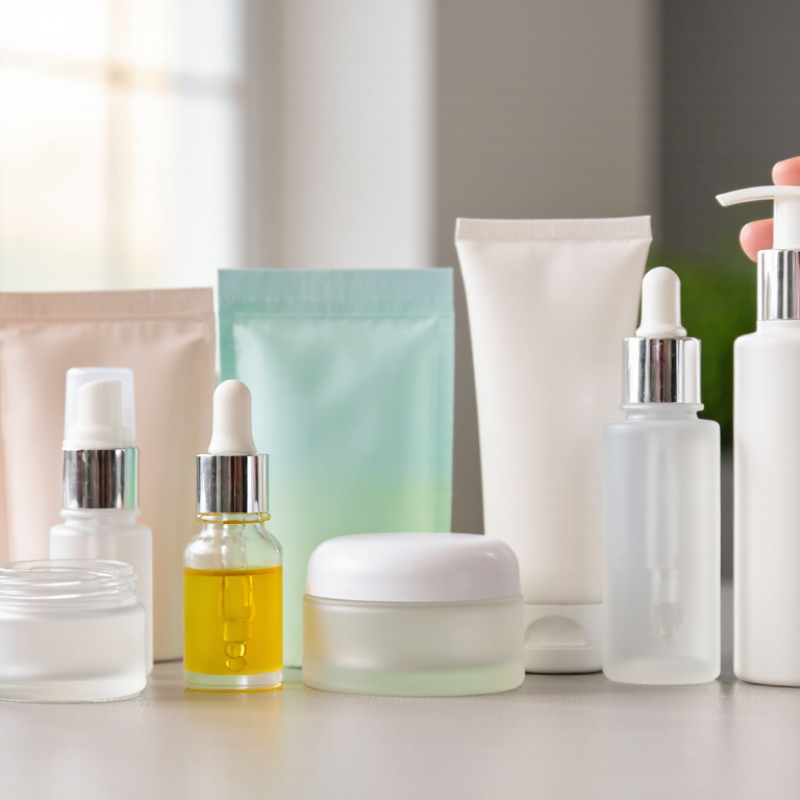
Packaging decisions should begin with market requirements, not visual trends. A glass jar may suit one region, yet breakage and shipping emissions can weaken its appeal elsewhere. Map climate, transport distance, retail conditions, recycling access, and filling capabilities before selecting materials. Local distributors should confirm whether collection systems can process pumps, coatings, and mixed components.
Consumer expectations are also measurable. The Capgemini Research Institute reported in 2023 that 79% of consumers were changing purchasing preferences based on environmental impact. Its research also found that 64% would pay more for sustainable products. These figures support responsible design, but they do not justify vague claims. Consumers still expect clean dispensing, secure closures, readable instructions, and consistent product protection. A recyclable pack that leaks in a humid bathroom is not a successful solution.
Use packaging tests that mirror real use. Store samples at high temperatures, drop them after long transport, and test pumps with oily formulations. Keep labels legible after water exposure. Packaging teams often overestimate consumer patience. A refill system may reduce material use, yet complicated cleaning steps can discourage adoption. That weakness deserves honest review. Smithers’ sustainable packaging research identifies recycling infrastructure and material efficiency as continuing market priorities. Requirements should therefore be recorded by country, customer group, and sales channel. Small details matter: a child-resistant closure, a barcode readable under soft lighting, or a cap that remains usable with wet hands. Practical evidence should guide the final specification.
How to Choose Skincare Packaging for Global Markets?
Packaging must protect skincare before it promotes sustainability. A delicate serum needs a strong oxygen barrier. A cream jar needs a closure that resists leakage during air transport. Packaging trials should test compatibility, seal strength, drop resistance, and temperature changes. ISO 22716-aligned quality controls can support safer cosmetic production.
Material choice also depends on local recycling systems. The OECD Global Plastics Outlook reports that only 9% of plastic waste was recycled globally in 2019. Recyclable in theory is not always recyclable in practice. Mono-material HDPE or PP can simplify sorting, while glass offers strong chemical stability but increases transport weight. Recycled plastic may reduce virgin material use, yet it can show color variation, odor, or inconsistent supply. That trade-off deserves honest review. UNEP’s Turning off the Tap report states that plastic pollution could be reduced by 80% by 2040 through reuse, recycling, and redesign.
Tips: Request migration and compatibility data from suppliers. Test the filled pack, not only the empty component. Check recycling claims for each target market. Keep labels removable where possible. Avoid unnecessary decoration. A beautiful pack that damages easily is not sustainable. I still find “fully recyclable” claims too broad when collection infrastructure remains uneven. Data should be checked market by market.
Recycling-rate benchmark by packaging material, based on U.S. Environmental Protection Agency municipal solid-waste estimates for 2018.
Key insight: Paper and paperboard showed the highest recycling rate among the selected materials, while plastics had the lowest. For skincare packaging, material selection should balance product protection, compatibility, local recycling infrastructure, and the use of lightweight or recycled content.
Source: U.S. Environmental Protection Agency, Advancing Sustainable Materials Management: 2018 Fact Sheet.
How to Choose Skincare Packaging for Global Markets?
Adapt Packaging Design to Regional Regulations and Cultures
Skincare packaging must satisfy local rules before it attracts attention. Ingredient names, net quantity, warnings, and responsible-party details may require specific formats. Some markets also demand local-language information. Others restrict cosmetic claims that suggest medical results. Confirm every label with qualified regional specialists. Rules change more often than design teams expect.
Culture affects packaging choices in quieter ways. A white box may suggest purity in one region, but mourning in another. Fragrance imagery can feel luxurious to some consumers and overwhelming to others. Test colors, symbols, and translated phrases with local participants. Avoid relying only on internal opinions. A small focus group can reveal an awkward meaning before production begins.
Packaging should also suit local use conditions. Airless pumps help protect formulas in humid climates. Wide jars may be inconvenient for consumers with limited bathroom space. Tamper evidence can build trust where imported products receive extra scrutiny. Select materials that local recycling systems can actually process. “Recyclable” is not equally practical everywhere.
I have seen teams approve elegant packaging too quickly. The design looked refined, yet the instructions became unreadable after translation. That mistake is easy to repeat. Leave space for regulatory text, batch information, and future language changes. Keep the opening method intuitive. Regional adaptation is not decoration; it is a daily user experience shaped by law, climate, and cultural expectations.
Choosing skincare packaging for global markets requires more than attractive colors and a premium finish. Functionality must survive different climates, transport routes, and consumer habits. Airless pumps can help protect sensitive formulas from oxidation. However, they may complicate recycling because several materials are tightly combined. Test pumps at low and high temperatures, then measure leakage after vibration trials. Small failures become expensive returns.
Branding should remain recognizable without relying on local language alone. Clear icons, tactile details, and readable dosage instructions improve shelf communication. McKinsey’s 2023 Global Sustainability in Packaging survey covered more than 11,000 consumers across 11 countries. It found that consumers consistently value recyclable packaging, although priorities differ by market. Treat that finding carefully. Sustainable claims need evidence, not vague green language. The OECD’s Global Plastics Outlook reports that only 9% of plastic waste was successfully recycled in 2019. Material choices therefore deserve technical review.
Supply chain efficiency often decides whether a good design survives commercial reality. Standard bottle formats can simplify sourcing, pallet loading, and replacement orders. Lightweight components may reduce freight emissions, but thinner walls can increase breakage. A practical audit should compare resin weight, mold availability, filling-line compatibility, and regional recycling access. McKinsey also reported that 60–70% of consumers may accept higher prices for sustainable packaging, depending on the category. That does not guarantee purchase. Cost still matters. The uncomfortable lesson is that one universal package may be less efficient than a carefully adapted system.
How to Choose Skincare Packaging for Global Markets?
Packaging for global skincare distribution must survive more than warehouse storage. It may face humidity, freezing temperatures, vibration, and repeated handling. In my experience, small details often cause the largest failures. A pump can stop working after shipping. A jar may develop hairline cracks near the lid. Test the complete package, including the container, closure, label, and formula. Use temperature cycling, drop testing, leakage checks, and compatibility studies. Record every result with batch numbers, photographs, and test dates. Reliable documentation supports certification and helps teams investigate unexpected defects.
Tips: Test filled samples, not empty containers. Check product weight after storage. Inspect pumps after repeated use. Ask independent laboratories to verify safety and performance. Packaging materials should also meet the destination market’s applicable requirements. Certification needs careful review because one approval may not cover every region. Keep technical files organized and easy to update. It saves time later.
Scaling production requires discipline. Approve a pilot batch before ordering large volumes. Confirm color, wall thickness, torque, decoration, and dispensing performance. Small production changes can create noticeable differences. This happened during a trial when a slightly different spring affected the pump output. The issue was fixable, but the schedule suffered. I would not ignore that lesson. Build inspection points into production and retain reference samples from every approved batch. Global distribution rewards preparation, but real-world packaging still needs regular reassessment.
| Market or Distribution Condition | Recommended Packaging Format | Primary Packaging Risks | Recommended Validation Tests | Relevant Standards or Documentation | Scale-Up Decision Criteria |
|---|---|---|---|---|---|
| European Union | Airless pump, tube, jar with inner seal, or compatible dispenser | Formula–pack interaction, leakage, incorrect product information, restricted substances, and inadequate preservation after repeated opening | Compatibility and stability testing; pump or closure functionality testing; leakage testing; transport simulation; package cleanliness inspection; preservative efficacy testing for the finished cosmetic product | Regulation (EC) No. 1223/2009 Cosmetic Product Safety Report; Product Information File; responsible-person records; ingredient and labeling review |
Scale when validated Approve production after confirming specification limits, artwork control, batch traceability, and supplier change notification procedures |
| United States | Tube, pump bottle, dropper, jar, or refillable pack selected according to formula viscosity and dispensing needs | Leakage during parcel shipping, misleading cosmetic claims, incompatible materials, undeclared fragrance allergens where applicable, and incomplete facility or product records | Container-closure compatibility; drop and vibration testing; seal integrity; dispensing-dose consistency; accelerated stability; label and claim substantiation review | FD&C Act MoCRA Facility registration and product listing obligations may apply; maintain safety substantiation and adverse-event records |
Controlled scale-up Confirm marketplace-specific labeling, batch coding, complaint handling, and packaging performance for parcel delivery |
| United Kingdom | Airless dispenser, squeeze tube, lotion pump, or sealed jar with tamper-evident protection where appropriate | Post-Brexit documentation gaps, inaccurate labeling, leakage, microbial contamination, and packaging components that do not tolerate temperature changes | Thermal cycling; compatibility; closure torque; leakage and seal integrity; shipping simulation; label durability; finished-product stability | UK Cosmetic Regulation Product Information File; Cosmetic Product Safety Report; UK responsible-person and notification requirements where applicable |
Scale with separate control Maintain artwork and compliance records separately from EU versions when market requirements differ |
| Japan and South Korea | Small-volume tubes, pumps, droppers, and compact primary packs with high-quality printing and precise dosing | Small text becoming illegible, dose inconsistency, pump clogging, packaging deformation, and local-language labeling errors | Dose-weight consistency; actuator fatigue; clogging assessment; print adhesion and rub resistance; thermal cycling; drop testing; compatibility with low-viscosity formulas | Local cosmetic labeling and ingredient requirements; retain formula, packaging, safety, and quality records in the required local format |
Conditional scale Use approved local-language artwork, verify mandatory label fields, and confirm that small-format packaging remains readable |
| Hot and Humid Distribution | High-barrier tube, airless pump, coated glass bottle, or moisture-resistant secondary carton | Oxidation, water loss, label lifting, adhesive failure, corrosion, microbial growth, and viscosity changes | Accelerated stability at elevated temperature and humidity; water-vapor or oxygen-barrier assessment where relevant; adhesive aging; corrosion check; seal integrity | Material specifications; supplier declarations; stability protocol and acceptance criteria; packaging change-control records |
Scale after climate validation Set storage and transport limits based on data rather than assuming that ambient conditions are equivalent worldwide |
| Cold-Chain or Winter Parcel Routes | Flexible tube, impact-resistant plastic bottle, or dispenser designed for low-temperature viscosity changes | Brittle components, cracked closures, pump failure, increased formula viscosity, and leakage after freeze–thaw cycles | Freeze–thaw cycling; low-temperature dispensing; drop testing after conditioning; torque testing; seal integrity; formula homogeneity review | Internal packaging specification; defined temperature excursion limits; transport qualification and deviation records |
Conditional scale Release only after confirming acceptable dispensing and container integrity across the planned temperature range |
| Global E-Commerce and Parcel Delivery | Compact, leak-resistant primary pack with protective secondary packaging and tamper-evident features where needed | Drops, vibration, compression, leakage, scuffed decoration, damaged cartons, and customer returns caused by poor opening experience | Drop, vibration, compression, environmental conditioning, seal integrity, closure retention, and complete packaged-product transport simulation | ISTA 3A ASTM D4169 Select the protocol according to parcel size, distribution channel, and shipping profile |
Scale after route simulation Validate the complete shipping configuration, not only the primary container |
| Child-Resistant Requirement | Child-resistant closure or dispenser only when required by product type, local law, or a documented risk assessment | Accidental access, excessive opening force for adults, incorrect closure re-engagement, and failure after repeated use | Child-resistant effectiveness testing; senior-adult usability testing; repeated-use cycling; torque and reclosure assessment | ISO 8317 16 CFR Part 1700 The applicable standard depends on the destination market and product classification |
Certification-dependent Do not claim child resistance until the applicable test method, sample configuration, and certification requirements are satisfied |
| Refill and Sustainability Program | Refill pouch, replaceable cartridge, reusable outer pack, or mono-material pack where performance and hygiene permit | Contamination during refill, incorrect assembly, material incompatibility, incomplete emptying, and recycling claims that are not locally valid | Refill-cycle durability; leak testing; cleaning or hygiene validation where relevant; component compatibility; emptying assessment; recycling-claim evidence review | Packaging material declarations; local recycling guidance; environmental-claim substantiation; extended producer responsibility obligations where applicable |
Scale by market Use region-specific disposal instructions and avoid universal recyclability claims without local infrastructure evidence |
| Manufacturing Scale-Up | Standardized components with approved tolerances, automated filling compatibility, and controlled decoration processes | Dimensional variation, pump misalignment, fill-weight drift, color variation, component shortages, and supplier changes | Pilot production; line trials; capability studies; fill-weight checks; closure application torque; visual inspection; barcode and batch-code verification | ISO 9001 ISO 22716 Quality agreements; approved drawings; inspection plans; lot-release criteria; change-control procedure |
Scale after process capability Approve tooling, production tolerances, inspection frequency, minimum order quantities, and contingency suppliers before launch |
Start with climate, transport distance, retail conditions, recycling access, and filling capabilities. Visual trends come later.
Recycling systems differ widely. One region may process pumps, while another accepts only simple containers.
They expect lower environmental impact, clean dispensing, secure closures, clear instructions, and reliable product protection.
Use filled samples. Apply heat, cold, vibration, drops, humidity, and repeated handling.
Testing can expose blocked pumps, leaking closures, hairline cracks, and weakened labels. Small failures matter.
Test the container, closure, label, and formula together. Oily formulas may affect pumps differently.
Record batch numbers, photographs, test dates, product weights, and inspection results. Keep technical files easy to update.
Approve a pilot batch first. Check color, wall thickness, torque, decoration, and dispensing performance.
Complicated cleaning can discourage users. Material savings may fail if the process feels inconvenient.
Yes. Transport damage, wet-hand use, and soft lighting may reveal issues missed during development. Reassessment is necessary.
Choosing the right packaging for international skincare products requires a balance between consumer needs, product protection, sustainability, and operational efficiency. To understand how to choose skincare packaging, businesses should first study target-market expectations, including preferred formats, usability, appearance, and environmental concerns. Packaging materials must protect formulas from light, air, moisture, and contamination while supporting responsible sourcing, recycling, or reduced material use.
Global packaging design should also be adapted to regional labeling rules, language requirements, cultural preferences, and consumer habits. Practical features such as dispensing control, portability, durability, and accessibility should work alongside a clear visual identity. At the same time, packaging must fit production capabilities, shipping conditions, storage requirements, and supply-chain budgets. Before launch, companies should conduct compatibility, stability, safety, transport, and usability testing, complete applicable certifications, and confirm that packaging can be produced consistently at scale. This structured approach helps create skincare packaging that is safe, attractive, compliant, and suitable for diverse global markets.

Ariqa Fashion